


The Observer newspaper in the UK recently alerted its readers to an event taking place at the Criterion Theatre, London on 8th December. Click here for story.
As you will see, the premise of the evening was founded on the vexed question of whether the plays attributed to Shakespeare are still funny or not. The event as described was highly contrived of course – with a faux legal set up providing a verdict – but it was aimed at schools and was performed for charity so one cannot view it too cynically. We were unable to attend and one can only hope that it went well and that decent sums were raised in aid of the Coram Shakespeare Schools Foundation.
The central question of whether the plays are still funny or not is an interesting one and particularly so with regard to youngsters coming to them for the first time. As we know, the plays can be very difficult for young people nowadays who often struggle with the language and cannot see the relevance in studying them, never mind finding any humour. Indeed, this applies not only to young people. I think the Observer article addresses this point when it raises the matter of performance. For I would agree with most young (all?) people that the plays are very rarely funny on the page and that most of the humour is to be found in performance.
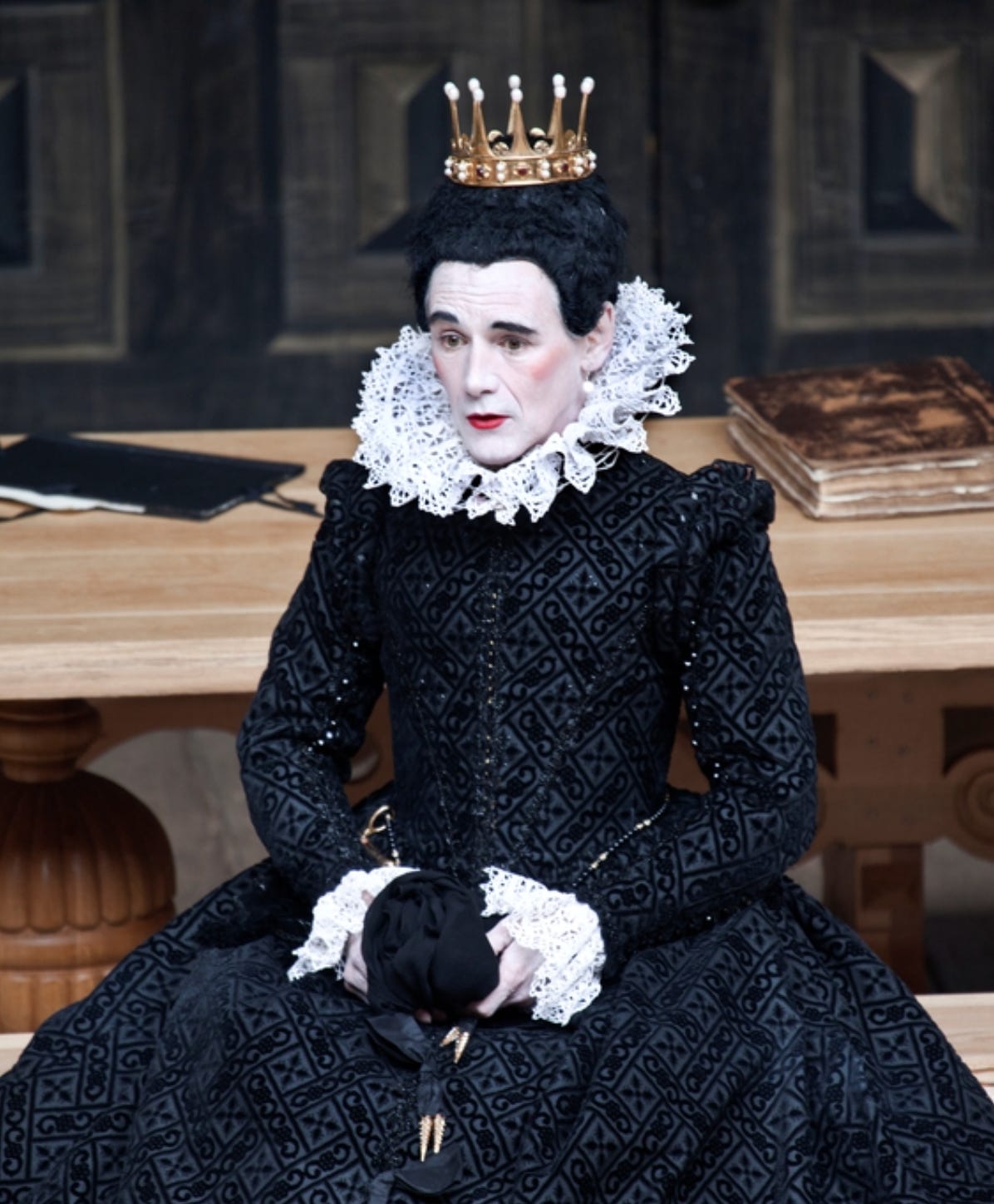
We will all have examples of plays we have been to see that we found very funny and for me Mark Rylance’s portrayal of the Countess Olivia in Twelfth Night (2012) at the Globe Theatre makes a clear case that these plays can still be very funny indeed. Interestingly, Mark also made his portrayal of Richard the Third (2012) equally funny, though the humour was dark; in fact, it was pitch black. On the page however I am not so sure.
The Observer article is interesting in two further aspects for us involved in the authorship question. Firstly, we have the suggestion of a new co-author in the actor Robert Armin. Actor and comedian (and it would seem researcher) Tim FitzHigham believes that Armin contributed comic passages to the plays he was involved in. The research that has led him to this conclusion he has been undertaking for the Shakespeare Institute in Stratford-upon-Avon.
Yes, you read that correctly. Research coming out of Stratford-upon-Avon is arguing that another author contributed to plays traditionally attributed to Shakespeare.
Yes, you read that correctly. Research coming out of Stratford-upon-Avon is arguing that another author contributed to plays traditionally attributed to Shakespeare. And this is reported in a mainstream, quality newspaper without any reticence or need to query. FitzHigham makes some rather overblown claims in the article: “We could not have had Fawlty Towers or Blackadder without … [Armin]”; and he “believes Armin … is the true font of all British wit”; but his proposal that Armin contributed to the plays would not seem to be one of them. Perhaps I am being oversensitive due to past experience but to read an article in a mainstream UK newspaper that deals, albeit secondarily with the Shakespeare Authorship Question without a resort to ridicule or some kind of put down is surely a sign of great progress in the normalisation of the authorship issue.
Perhaps I am being oversensitive due to past experience but to read an article in a mainstream UK newspaper that deals, albeit secondarily with the Shakespeare Authorship Question without a resort to ridicule or some kind of put down is surely a sign of great progress in the normalisation of the authorship issue.
What do you think regarding the plays? Funny, not funny? Do you have a quote/line that you find particularly funny on the page? What of a favourite funny performance? Or do you think the humour has gone, is too dated?
Oh, what a complex question you've asked us! There's a lot I've laughed at in Shakespeare over the years, but plucking out specific examples is tricky. In performance, timing and style of delivery is crucial. So much verbal humour (oral and written) depends on context, and on both cultural and individual associations. The Elizabethans and Jacobeans loved word play and layers of meaning. Shakespeare's humour (like that of many modern British comedians) often relies on the double entendre (Sp?) which the Brits and those of us inhabiting some of their former colonies get, while others with English as a first language don't. The double entendre goes back to Chaucer and beyond. Its prime example of nowadays is the Graham Norton show, when Graham and his brit guests start talking bawdy, the audience are in hysterics, and USA guests often sit their looking blank.
Another source of humour is the juxtaposition of contrasting elements to create a sense of the absurd. Chaucer did this in The Canterbury Tales; Thackeray and Jane Austen both do it (though more politely) and some of the Jacobean revenge tragedies are riddled with it. The shock of their particular form of absurdity is part of their appeal.
So, true confessions time. First impressions are important. I'd never seen or read Titus Andronicus until the (1985?) BBC production screened on TV here in New Zealand in the late 1980s. I watched it while alternately giggling or saying, "Ugh, yuck," which is pretty much my response to modern splatter movies. Would the Elizabethans have found it as funny as I did? Who can say? Though I suspected some of the odder lines were in there to give the actors a chance to laugh, rather than keep their faces stony-straight.
My own experience is that in performance, all too often, many of the jokes are missed. People go away with the impression that the plays aren't funny, or even entertaining. That's one of the reasons I wrote my screenplay adaptation of The Merry Wives of Windsor - to encourage young people to appreciate and enjoy the plays